Baja 1995
By Robert afSandeberg (email surain_robert@hotmail.com) Distances are in nautical miles (1 nm = 1.15 statute miles).
It is still dark outside as we leave the hotel room and carry the kayak down to Mulege river, finish putting our Double Nautiraid kayak together, and start packing it. We have now owned our folding kayak for two and a half years, and finally our dream is coming true: To fly with it with all supplies and gear and paddle wherever we desire. But will everything fit? There was not room in our houseboat to try it out first (and we did not want to expose everything to the constant rains). We do have to squeeze it in, especially the 40 liters of water we are carrying. There won't be any fresh water for a week or more.
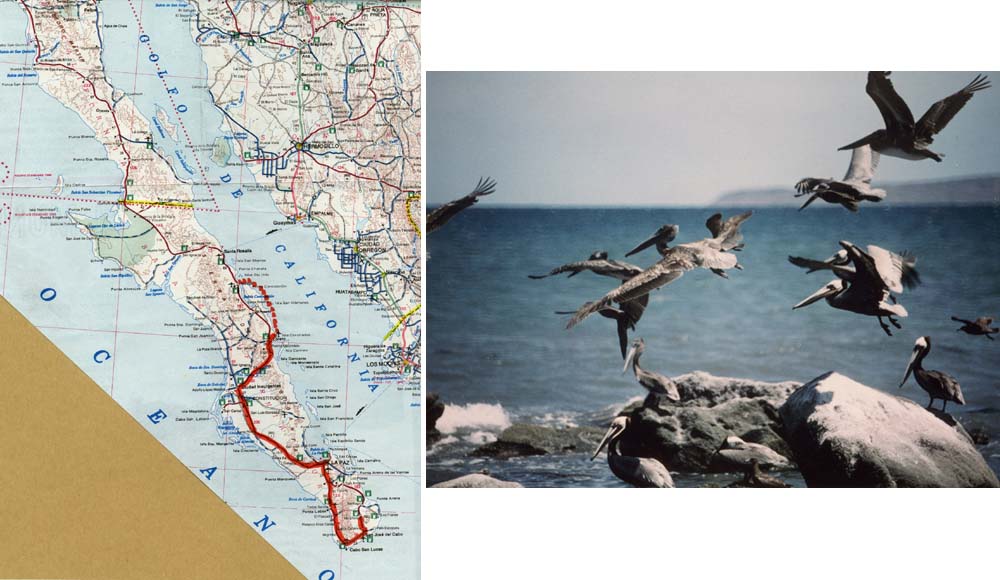
The sun is just coming up as we push off into the Sea of Cortez. The wind is light and as soon as we leave the river we also leave the trees behind. Baja is a semi-desert, a stark but beautiful landscape where the cacti range. We follow the coastline to the south and then cut across the Bahia Conception. After two and a half hours paddle we step ashore at the other side of the bay to rest a bit. Just north of us there is a little village that seems abandoned. There are no other signs of life.
Our plan is to paddle south with the prevailing northerly wind in our back. But first we must go north a bit to round Punta Santo Domingo and then Punta Conception. As we head out again there are sudden strong gusts of wind from the north in our face and big steep waves hit us. We quickly put on our sprayskirts, one at a time to keep pointing upwind. But the wind is howling and the waves get bigger. After rounding the points we need to paddle two miles with the wind from our side - quite uncomfortable in big waves - before we can turn downwind. It doesn't take us long to realize that we won't paddle any more today, so we paddle back to shore and pitch our tent.
Getting there
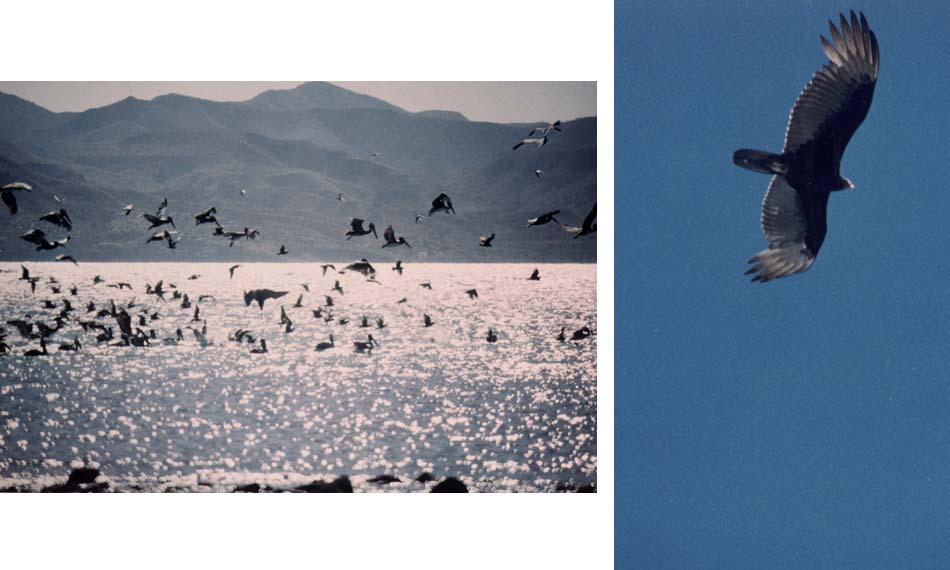
We had flown from Seattle to Loreto and caught a taxi from there to a nice hotel in Mulege. Mulege is a pleasant community with a river and some green trees. We spent a day in there worrying about the howling wind while enjoying all the pelicans, vultures and other birds. We had elected to start in late March, during the end of the windy season. "Febrero es loco e Marzo un poco mas" as the Mexicans put it (February is crazy and March a little bit more). Friends had told us that afternoons are very windy but mornings are usually calm. In fact, an outfitter had told us that when they run kayak tours down here, they get up at 4 am and climb a hill. If there is any wind at all at that time, they won't paddle that day. Well … had we followed that advice, we would have stayed in Mulege all the time.
Heading South
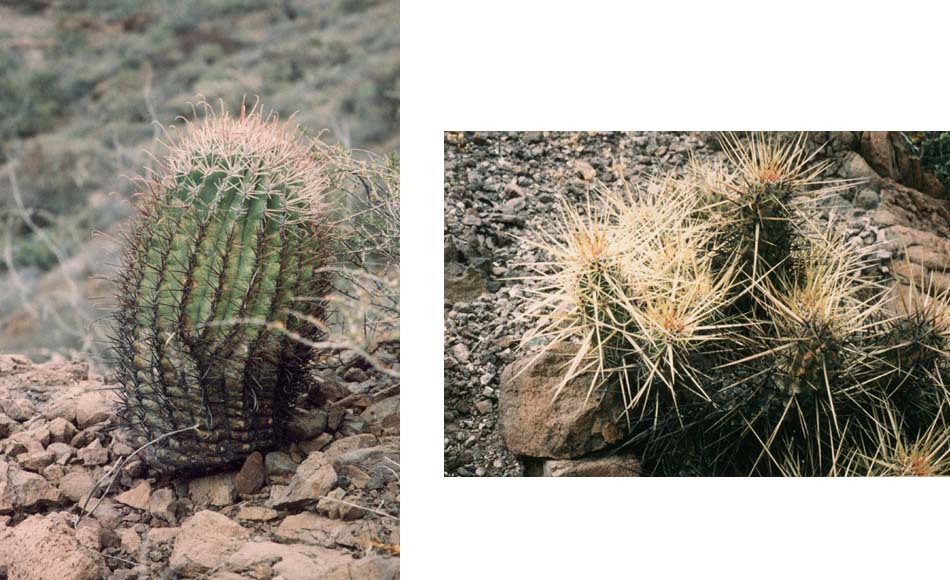
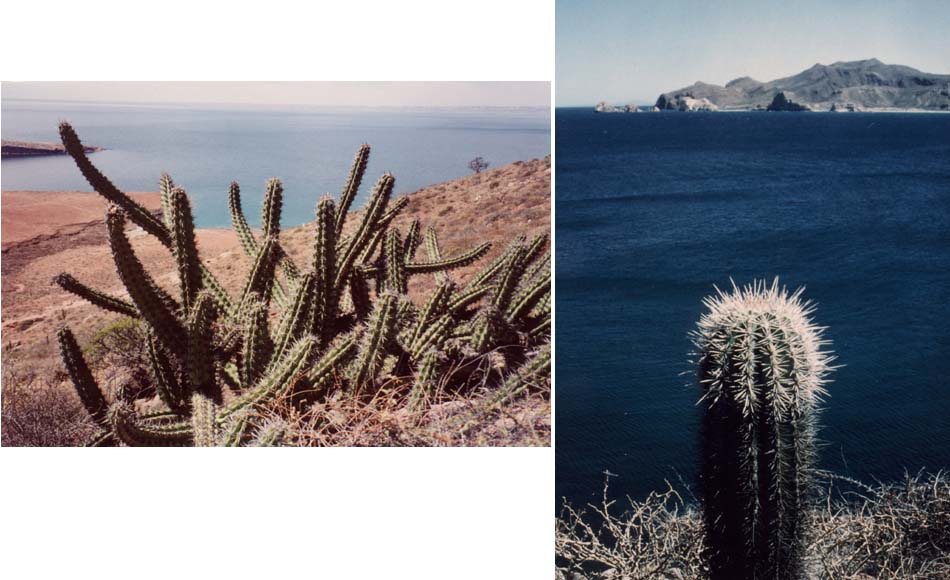
After our early takeout the first day, we enjoyed exploring the abandoned village and hiking around the beautiful cacti. This was definitely far from a dead desert! Above us large turkey vultures cirkled around, looking for pray to swoop down on. But the pelicans really caught our attention. They were everywhere and really put on a show in the afternoon. We sat under the tarp watching them dive into the water. Or maybe I should say plopped down. Pelicans are big heavy birds and don't get far into the water!
With the strong wind arriving around 10 the first day, we quickly decide to make early departures in the future. We set our alarm for 5:20 when it was still dark and took off around 6:30 at sunrise. Almost calm the next morning and small waves. What happened to the big crashers from yesterday? We loved watching the semi desert from the kayak, there was so much life there despite the dryness. But not much life in the ocean. There were a few Mexican fishing boats but no kayaks or other pleasure boats. In fact there was a 24 hour period when we didn't see a single other person.
We got into a rhythm to paddle from 6:30 until the wind kicked up, usually about 10:30 in the morning. After about a 12 nm paddle we would go ashore, swim, prepare our lunch, and then go hiking. We seemed to see different aspects of the desert every day. There was the stately El Cordón cactus, the plump Barrel Cactus, the Galloping Cactus that spreads its tentacles sideways, the Elephant Tree, and many more.
At one place we had seen a small cave full of boxes. What were they and what were they doing here? As we enjoyed some books before dinner, a Mexican fishing boat pulls in. The three Mexicans looked uneasily at us and wondered if we planned to spend the night. They said that they would, too. But something was not right here. An hour later they walked into the cave and started carrying all the boxes into their boat. It was hard work for two of them (the third person just watched them), but finally they were done and took off with their loaded boat, heading north against the strong wind. What were they? A contraband?
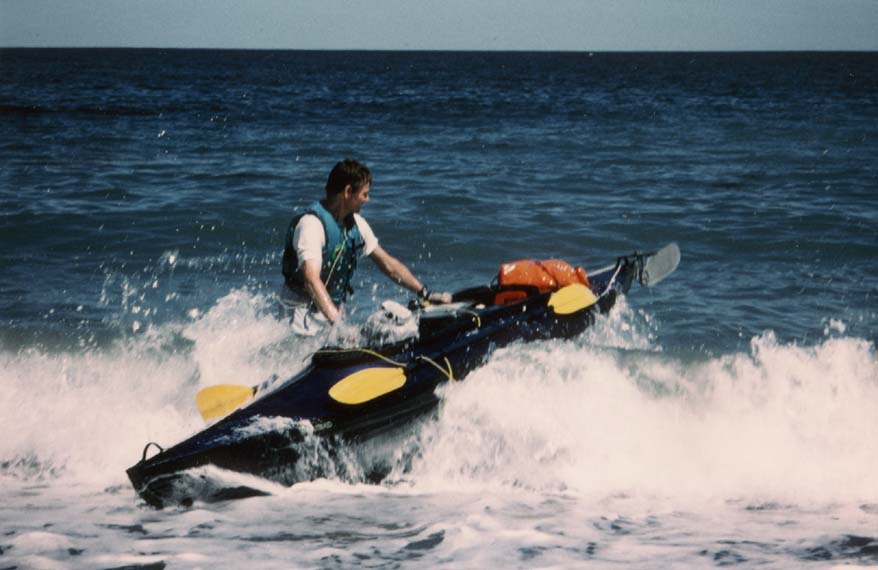
Surf landing was not one of our skills before this trip, but at times we had no choice if we wanted to go ashore. Our method was simple and worked well in the comparatively small waves in the Sea of Cortez (and warm water!). Just before the breaker it was shallow enough for me to barely touch the bottom, so I jumped in and held the kayak. Surain carried in some of the heaviest items (like water). We then covered the cock-pit with the spray skirts and walked the boat in and could quickly get it out of the surf zone because of the reduced weight. Exiting into the surf was much easier, so we just paddled out.
El Pulpito
We could see El Pulpito from far away. From our camp site it looked like an island due the curvature of the earth. It took us a full day to get there (I mean half a day, of course). It is a gigantic rock perched at the end of a point and can be seen from a long distance. As usual, we followed the coast to the south. We saw the first little village en route, it was very small and only had a few houses there. It looked very poor but it did have a road, the first we had seen for three days.
We took a short break at 10:30. As we continue the wind started picking up - right on time. But we were so intrigued by El Pulpito that we continue anyway. As we follow the coast to the east, white caps formed quickly and the wind pushed us from the side, an uncomfortable position to be in. At Punta Santa Antonia we swung around to the south and got the wind behind us. It was very rough right at the point, and we learned later that this is a dangerous point where some kayakers have perished.
I judged the wind to be at least 20 knots and there were white caps everywhere, but it seemed a little protected where we were in lee of El Pulpito. But what was that in the water ahead of us? A school of dolphin playing in the waves! Seeing animals as gracious as these is a real delight, but we didn't want to unzip the spray skirts, so we had to remember them in our mind.
It was hard to get the tent to stay in the strong winds. There was also sand, sand everywhere and we couldn't escape it. After lunch we hiked up to the top of El Pulpito. At 475 feet above the sea, the view was breath taking. We could see 360 degrees around the horizon and could easily make out many pointws we had passed. The waves far below looked "loco". Almost straight below there was a Mexican fishing boat. People were sleeping in it waiting for darkness when they could fish with a light.
Bahia San Juanico
The next morning we arrived at Bahia San Juanito a little after ten, just as the wind started picking up. But what a delight that met our eyes! A very protected cove with safe anchorage and beautiful beaches. There were also several American sailboats. There is no safe moorage north of here for them, so this is the northern end of the cruising area. People seemed to have a very comfortable life in their boats. We also noted joggers on the beach. It was too early for lunch, but it was obvious that we would go no further today. We lazed away the day, snorkeling, hiking, and exploring the area.
It took us another day and a half to reach Loreto, where we took out. We had been out paddling for a week in magical surrounding. Yes, we had heard so much about kayaking in Baja, but our expectations had certainly been exceeded. We found a mostly pristine environment with hardly any people at all. There were two groups of kayakers, one or two tourist with cruising boats, and Mexican fishing boats. And this in an entire week!
Paddling distances (nautical miles):
-----------------------------------------------------------------
Monday Mulege 	-> Punta San Domingo 	 	 9 (7:00 - 10:30)
Tuesday 	-> before Punta Santa Rosa 	13 (6:30 - 11:00)
Wednesday 	-> Punta Santa Theresa 		11 (6:45 - 11:35)
Thursday 	-> El Pulpito 			15 (6:30 - 12:00)
Friday 		-> Bahia San Juanito 		11 (6:45 - 10:20)
Saturday 	-> a beach 			14
Sunday 		-> Loreto 			11 (6:30 -  9:30)
-----------------------------------------------------------------
Total 84 miles (97 statute miles) in 6 1/2 days
La Paz
We hopped on a bus for a five hour ride to La Paz, the capital of Baja California Sur. This is a pleasant city for strolling around, taking a brake from the paddling, enjoying liquados (all kinds of fruit juices -- we must have improved their business quit a bit!), eating Mexican food and enjoying life in general.
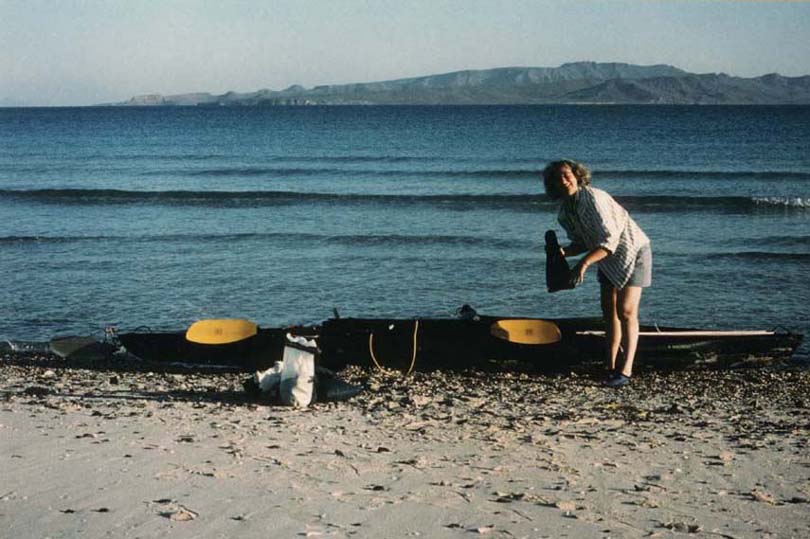
But we soon headed out again. A very early 1/2 hour taxi dropped us off at Playa Tecoloto, just across from Isla Espiritu Santos. This is a 4 nm open water crossing (see the top picture). Isla Espiritu Santos is probably the most popular kayaking destination in Baja, and for a good reason. The island and the smaller Isla Partida just north of it are delightful with many nooks and crannies. Beaches abound and short hikes to the top of some cliffs yields wonderful views. At many places there are magnificient rock formations. Another advantage is that it is easier to find protection from the ferocious Baja winds here than in our first week's paddle.
Isla Espiritu Santos
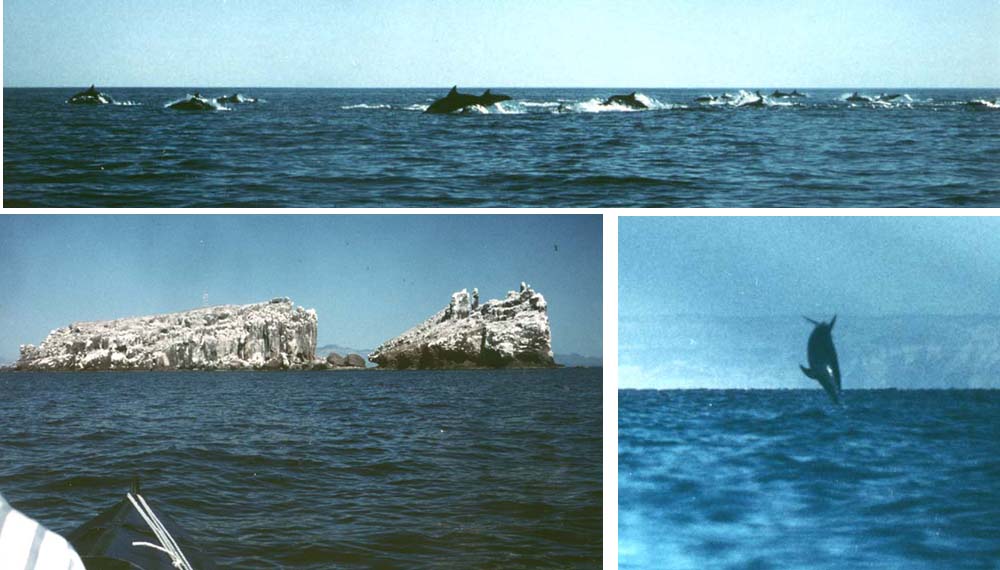
There was hardly any wind today and we had a joyful paddle to the other side. Dolphins! Yes, we had seen dolphins before, but here they were everywhere. A school of about ten of then passed by very close so we could even hear them breath. They were playful and jumped clearly out of the water while we sat still in awe, trying to remember it and catch it on pictures. At another place we were away from shore and were surprised by the noise from the breaking waves, we were too far from shore. But as we turned around a school of about 50 dolphins emerges, swimming quite close to us. The sleek animals effortlessly propelled themselves while skipping out of the water. This was what we had hope to see in Baja and much more!
Our campsite was delightful with sandy beaches but tiny gravel for the kayak and the tent. There was protection from the sun most of the time. Swim or snorkel right there - whatever we preferred. We easily recognized the pretty Sally Lightfoot crabs from Galapagos Islands. This was such a nice place that we decided that we had enough food and water to spend an extra day here, just reading, swimming, snorkeling, and hiking.
North of Isla Partida there are two tiny rocky islands a ways out in the water. This is a heaven for sea lions - and also for tour boats. But we were spared from these modern crafts when we paddled out to the islands. We checked out the sea lions both from the kayak and from the water with snorkeling gear. The sea lions were curious and came up to us, dove under us and the kayak, dove down again and then emerged from another angle. It seemed like they enjoyed the encounter as much as we did!
The wind was up the last day as we paddled back to Playa Tecoloto. But this was from the south, not the normal strong northerly wind. I remembered then having read that strong southerly winds are not uncommon early morning in the La Paz area. We struggled against the wind for about an hour and a half. Then we stopped near the crossing and went ashore. The sun was hot as we grabbed our books to wait it out. That did not take long, after less than an hour it was calm again. Then we did the crossing in choppy sea back to Playa Tecolote.
The sea food was marvelous in the little restaurant and we enjoyed the luxury of having someone wait on us. Nicely rested we asked the restaurant to call for a taxi. The shocking response was that there was no phone service out here! The waitress further informed us that it was unlikely that an empty taxi would drive up here on a weekday. We had already started taking our kayak apart. But it did not take us too long to figure out that there would be no rest for us for a while.
So we got back into the kayak and headed for La Paz. The sun was scorching hot and absolutely no wind. We often dipped all our cloth in the sea to cool off. There was one big plus with this paddle: We spotted a gray whale in the distance. Gray whales are common in Baja and especially on the ocean side, but that is a couple of month earlier in the season. It took us three hours hard paddling to get close enough to La Paz to find a public beach with a telephone. Yes, we were tired and dirty but could look forward to a nice bed in a hotel room for the night.
Isla Espiritu Santos and Partida were wonderful kayaking destinations well worth their fame. We did see a few tour boats, sail boats and other kayakers, but had no problem finding secluded beaches. Still, the first weeks paddle from Mulege to Loreto was easily our favorite.
Paddling distances (nautical miles):
----------------------------------------------------------
Tuesday   	Playa Tecolote -> Isla Partida  	15
Wednesday  	-> Puerto Ballena    			16
Thursday          					 0
Friday   	-> Playa Tecolote -> La Paz  		21
----------------------------------------------------------
Total 52 miles (60 statute miles) in 4 days (3 days paddling)