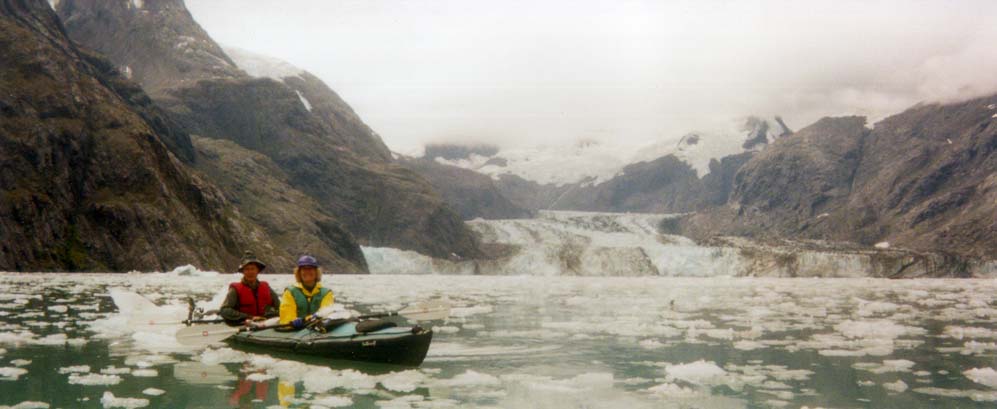
Glacier Bay September 1997
By Robert afSandeberg (email robert@afsandeberg.com) Distances are in nautical miles (1 nm = 1.15 statute miles).
The rain is increasing again as I serve the breakfast tabouli. Will it ever stop? It started - or should I say resumed? - during dinner preparations yesterday. But we quickly re-focus our attention when a black bear is spotted on the beach, ambling along toward us. We are excited to see our first bear and not too concerned, since black bears are generally not very aggressive. But we carefully seal up our five bear- proof canisters, which are compulsory food repositories in Glacier Bay National Park. Both brown and black bears are abundant in the park. It is inconvenient to put the tabouli back, so we decide this is a great time for eating it. The bear is obviously aware of us, but keeps coming closer in a rather nonchalant manner. He comes to a little over 100 yards from us and then disappears into the forest.
The tour boat Spirit of Adventure had dropped us off at Seebree Island five days ago. On that Sunday there were low clouds covering up the mountains, but the clouds were interesting too watch as they moved and reshaped around the hills we could see. From the tour boat everybody was excited to see humpback whales in the distance, even breaching at times. South Marble Island offered more excitement, as tufted puffins were spotted high up on the cliffs. More than a hundred Stellar sea lions were hauled out on the rocks. We watched a pup trying to scale a fairly steep rock wall. The wall was too steep, so the pup decided to clamber down into the water again over beds of oysters and blue mussels.
We saw the whales again from our kayaks. Surain and I paddled a Feathercraft K2 and Laura and Fred a Nautiraid Double, both folding expedition kayaks that we brought with us on the flight from Seattle. Gray harbor seals popped their heads above the surface to stare at us. These animals seemed very curious as they could remain in this position for long periods. Brown Stellar sea lions were much larger, but only surfaced for a moment to breathe. Dark harbor porpoises at times swam quite close to us. Fred's hawk eyes spotted a mountain goat graze high up on a steep slope. Several bald eagles were perched high up in trees. At times there were huge amounts of birds resting on the surface. They would scare easily and take off with hundreds of wings fluttering in the air. We recognized the black birds with some white on top and red feet as pigeon guillemots. The surf scoters were also gregarious but not as easily scared. With their black body and reddish beaks, they can be mistaken for puffins. We also saw occasional buffleheads and horned grebes. But the humpbacks saved the best for the evening. From our camp at the north entrance to Tidal Inlet we could both see and hear them feed in the bay close by. Most of these humpback whales migrate to Hawaii during the winter to breed. There is no food for them in the warm waters, so they have to prepare for a long fast. They seem to do this task well, feeding for 23 hours each day.
Monday was a beautiful day with lots of sunshine and we praised our good luck with the weather. We definitely spoke too soon! We slowly made our way deeper into the Western Arm of Glacier Bay fighting wind and some current. The views became grander and grander with snow-capped mountains gradually revealing themselves and hemming in three sides of our view. But the highest peaks were still hidden in clouds. Eventually we could look into Tarr Inlet and see how the mighty Grand Pacific Glacier at the northern end snaked down the mountains to become a tide-water glacier (a term denoting a glacier reaching all the way down to saltwater). We pitched our tents on an alluvial fan with the glacier still in view ten miles away. After dinner we made coffee and drank this with brandy. Meanwhile the sky was turning golden in a glorious sunset.
But the Grand Pacific glacier used to be much larger. When captain George Vancouver visited Glacier Bay in 1794, the glacier extended a further 65 miles to the south, completely filling what is now Glacier Bay. John Muir traveled here in 1879 to prove his theory that Yosemite Valley had been carved by glaciers, an idea ridiculed at the time. He found that the glacier had receded an incredible 48 miles. By 1916 it had receded to its present location, a further 17 miles. Such a rapid retreat of glaciers is known nowhere else in the world. Today the bay has some 12 tidewater glaciers, most of them either stable or growing.
I woke up during the middle of the night to hear rain fall on our tent. It continued to rain all night, so we had to cook breakfast, break camp, and load the kayaks in pouring rain. But first the kayaks had to be carried. It was low tide in the mornings and with a tide range exceeding 18 feet we found the kayaks parked quite some distance from the water's edge. Our carrying straps enabling four people to carry were a big help though.
There was something floating in the water. It dove quickly when it saw us, but soon popped its head. We were excited when we discovered the faces of two otters. Later we found out that they were most likely sea otters, an endangered species that is rarely seen further south. The rain kept increasing. We thought it couldn't get any heavier, but were proven wrong as new bursts of water plunged down on us. We had been told to expect rain and were glad to have long rubber boots and heavy rain gear as had been recommended.
We turned around a point to see Reid Glacier, a beautiful blue tidewater glacier about two miles away. Though it is not very active, there were some icebergs floating. But Lamplugh Glacier another three miles to the west was really stunning, full of translucent blue ice and heavily serrated. Part of its base had an incredibly deep blue color. There was quite an assortment of small icebergs floating around. We paddled and drifted slowly by it, looking for calving icebergs. Several times the air filled with a thunder-like sound and we caught a glimpse of some falling ice. But the wind bearing down on us from the glacier was really cold, so we didn't linger very long here.
We continued past Jow Point from where we could look into Johns Hopkins Inlet and glacier, the most active glacier in the bay. We had wanted to have lunch in the kayaks and then go into the head of this bay for a closer look at this very spectacular glacier. But as the rain kept pouring down we were getting chilled (except Fred who always exuded warmth) so we turned around. About 2« miles back we beached the kayaks at a stream opposite and with a good view of Lamplugh Glacier. Lunch and warmer clothes helped raise our spirits considerably.
An intended hike ended abruptly at a raging stream that we were in no mood to try to cross. Up the hill the brush was very thick and stopped us as well. On the way back to the tent we ran into some bear tracks. This area had been closed to camping due to an abundance of brown bears, but was now open again. The black bears don't like it here due to the lack of trees. We had been surprised at how quickly the vegetation had changed. The first two days big trees had lined every shore, but there were none up here, just grass and shrubs.
We rigged up our big tarp so we could cook dinner under shelter from the rain. We used two paddles to supplement the two poles we had brought with us. It was hard not to speculate what dinner was being served on the gigantic cruise ships plying Glacier Bay. Only two ships are allowed in the bay each day. But our own dinner was quite tasty, and the Cabernet wine vintage 1989 wasn't bad either. We made hot chocolate later and sipped some liqueur. Yes, it would take a cold and rainy day like today to dream about the comfort and luxury of a cruise ship, but we still pitied the passengers having such bad weather during their half day up here. Our view of the Lamplugh Glacier was magnificent and we could enjoy it as long as we wanted. Now and then it sounded like thunder as new icebergs calved.
I woke up many times during the night to roll over and was dismayed every time to discover that it was still raining. But neither Surain nor I woke up when a grizzly bear announced its arrival with some snorts. Laura and Fred told us the next morning. We all got up when it stopped raining about 8 am. Everything looked fine except that the tarp was on the ground. A gust of wind or a clumsy bear? We shall never know. There was a minor river in the "kitchen" area. It surely hadn't been obvious to us that this was a stream bed.
Laura went to a private corner, but immediately beckoned us to look down to the shore. There were five otters playing in and out of the water. Their small gray heads with the whiskers are so characteristic. They climbed on rocks, then swam for a while and seemed quite oblivious of our presence. Later we learned that they were river otters (you would never see more than three sea otters together, since they only have one pup). While river otters are fairly common further south, they are rarely seen up here.
The weather was much better today, though still cloudy. Our spirits were high as we again headed into Johns Hopkins Inlet. The inlet is like a fjord with very steep rocky sides and hardly any shore at all. A few slopes were draped in beautiful green colors, but mostly there were rocks of many different kinds and striations. And ice. We passed several tidewater glaciers and hanging glaciers. Some two miles from the glacier the ice floes were packed close together and we had to thread our way gingerly between them. Frozen ice can be very sharp and we were in no mood to take any chances with our skin kayaks, though they can take a lot of abuse. We were delighted to see many harbor seals resting on ice floes. When we came too close they would slip into the water. Johns Hopkins Inlet is a major breeding area for the seals, since their main predators the Orcas don't enter the milky glacial water. The inlet is closed to boat traffic in the beginning of the summer and to all motorized traffic until August 1 to protect the seal pups. However, a ranger later informed us that a kayak is often more disturbing to their breeding than a motorized vessel.
We were surprised by the small size of the ice-floes. We had seen calving glaciers before both in southern Chile and Prince William Sound in Alaska - though not from kayaks - and those were real icebergs. A few of the larger pieces here might be called ice-foothills. Sometimes they would start rolling over very slowly. Salt water melts the ice fast, eventually causing pieces to break off and change the balance. That is a time when you don't want to be close to the ice since it could unexpectedly hit the kayak. Close to 90% of the ice is under water. The milky water makes it impossible to see the ice or even the paddles under the water.
We stopped about a mile from the glacier when the thickening ice made it impracticable to proceed. And here we sat waiting, like many others before us. Suddenly the fjord would fill with the roaring thunder of a calving iceberg. But where did it calve? Sound travels much slower than light and by the time the sound reached us, the calving was already over. The only way to see the calving is to continuously scan the glacier and hope for luck. Sitting silently in the kayaks, taking pictures, eating our lunch, marveling at the glacier, the ice-floes, the dramatic landscape was a stunning confirmation of nature's grandeur.
On Thursday morning we paddled back to the Lamplugh Glacier to enjoy a closer look without rain pouring down on us. A huge cruise ship, the Regal Princess, turned into the bay. Its decks were full of people looking at us and the glacier and taking many pictures. As we tried to decide whether to choose the lobster or the oyster, had we been aboard the ship, we also came up with a new business idea: Contract with the shipping line to show up with our kayaks at photogenic spots and have our airfare, equipment, and all expenses paid for.
We had originally planned to paddle into Tarr Inlet for a closer look at the Grand Pacific and Margerie glaciers, but the rain had cost us a day in Johns Hopkins inlet so we came up with another scheme. Instead of being picked up by the Spirit of Adventure in Blue Mouse Cove and be taken back directly to the ranger station, we opted to paddle all the way back to Sebree Island, our starting point. From there the Spirit of Adventure would take us into Tarr Inlet on its day cruise of Glacier Bay before heading back to the ranger station.
The rain kept increasing after our Friday morning encounter with the black bear. There was lots of rain, low clouds, and poor visibility as we made the 3« mile crossing across Glacier Bay to the eastern shore. As I stepped out of the kayak for lunch on the other side, I noticed that most of my clothes were wet despite the protecting rain gear. This was the first time I felt miserable, being wet and cold. Surain took out her camera to capture the slipping spirit of the four kayakers.
Back in the kayaks the rain started to decrease and parts of the sky looked brighter. But it all happened so slowly, with the rain going from pouring to rain to heavy drizzle to drizzle to light drizzle to mist and then finally, stop completely. We were now close to Sebree Island. There were a few black oystercatchers sitting on a rock with their long, red beaks. A humpback whale greeted us with a big blow quite near us and then came up to breathe. It dove and disappeared for a while, but soon reemerged on our other side before getting further away.
The life-giving sun penetrated the clouds and we spread everything wet out to dry on the rocky beach. The only dry clothes on my body were my socks. The clouds dispersed and to my surprise it was suddenly warm enough to wear shorts. The humpback whale came back blowing, breathing and feeding. It spent at least two hours in our vicinity, at times quite close to shore. It was amazing that only a few hours ago we had been miserable in the rain at lunch, and now sat in the sun on front seats enjoying one of the great spectacles of nature, a humpback whale.
The Spirit of Adventure showed up promptly at 9 the next morning to pick us up. This turned out be a rare September day in Glacier Bay with not a cloud in the sky. We could see all the mighty snow-capped mountains feeding the glaciers, including 15,320 foot high Mount Fairweather. Further up north the boat slowed down in the passage between Russell Island and the eastern shore. There were some large animals swimming nearby, clearly not whales. But they didn't look like sea lions either, staying on the surface without diving. What were they? The voice of the ranger trembled with excitement as she announced "There are four bears swimming!" through the loudspeaker. Yes, the face and ears of grizzly bears were quite recognizable. They kept swimming to shore, bobbing up and down and floating with the current, for about ten minutes. We followed them for another twenty minutes as they climbed ashore and ambled north. There was a sow with three two year old cubs. One of the cubs was dark as a black bear, while the other three bears were brownish and much lighter. We understood the rarity of seeing swimming bears when a crew member said he had never seen it before though he had worked the ship for several years.
Sun 8/31: Seebree Island -> Tidal Inlet     10
Mon 9/1: Tidal Inlet -> W of Reid Glacier   13
Tue 9/2: Reid Gl. -> NW of Lamplugh Gl.     12
Wed 9/3: Johns Hopkins Inlet                11
Thu 9/4: Lamplugh Gl. -> Scidmore Bay       18
Fri 9/5: Scidmore Bay -> Sebree Island      15
Total 79 nautical miles (91 statute miles) Robert afSandeberg