The tropical air felt warm as we stood on the modern Indonesian ferry Ciremai. It was midnight and we couldn't see much in the darkness. I remembered a similar event 22 years ago, also on an Indonesian ferry, when I first crossed the equator. Then I was traveling deck class under a leaking tarp, and I could behold a magnificent thunderstorm. Though I had crossed the equator many times since, I always felt a tinge of excitement. This time we were traveling second class in comfort. Not that we felt a strong need for comfort - we would soon switch to tents - but it was nice to be able to lock all our gear in a cabin.
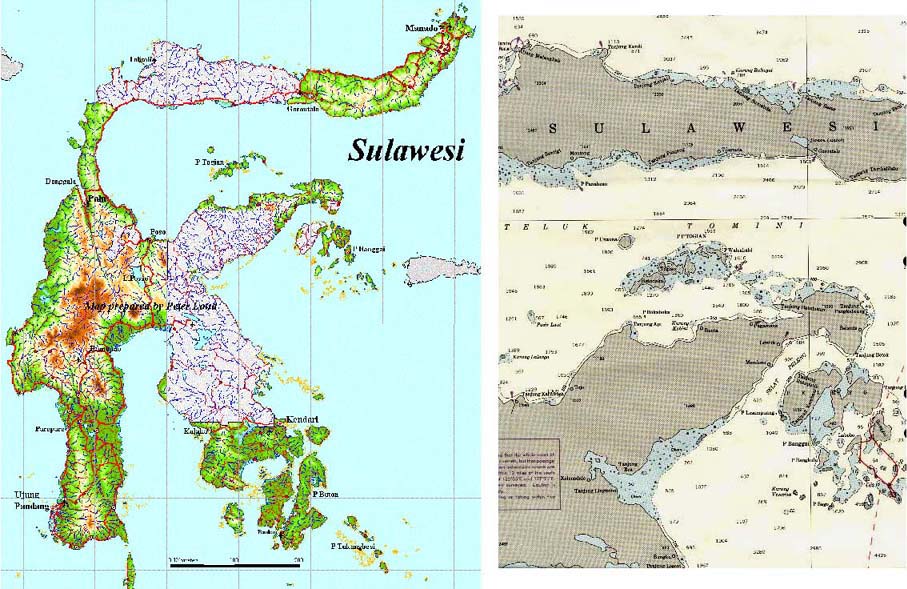
This moment also marked the beginning of my 50th birthday. I had felt somewhat uneasy over my brothers' and many friends' plans for formal dinners with speeches to mark their half century events. So I had decided to do something out of the ordinary instead, something that better fit my lifestyle. Now Surain, my wife of eighteen years, and Elizabeth, a close friend of almost as long, and I were heading to remote Banggai Islands off the east coast of Sulawesi, Indonesia. Since the big ferries only call here once every two weeks, we planned to paddle for two weeks. We had paddled the Queen Charlotte Islands, the Sea of Cortez and other places before, but this was a far larger undertaking and contained many more unknowns.
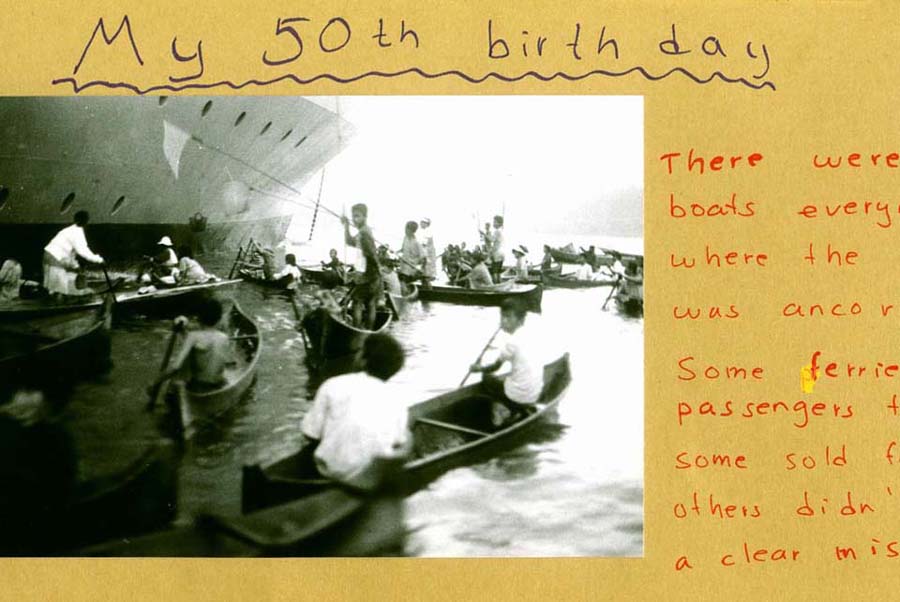
At 5:30 early the next morning, Ciremai dropped its anchor. This small tropical town near the equator did not have a deep water harbor. Though it was still dark, we could see many small boats approaching. Hundreds of dug-out canoes were making their way to the ship's side. Some of them ferried passengers and goods between Ciremai and the town of Banggai, while others brought fruits and other foods to sell to the passengers still on board. There were people of all ages, some children, younger women and couples, paddling the boats. In the small, wooden canoes we could make out a bewildering array of seafood, all neatly arranged in wooden bowls or on coconut palm leaves, as well as an abundance of tropical fruit. They used nets attached to long poles to reach up to the passengers leaning out from the ship above. At times items were lost in the water, but someone would immediately dive in to retrieve them.
After stiff negotiation - everybody bargains in Indonesia - we employed some porters to help us carry the two folding kayaks, food for two weeks, 80 liters of bottled water, and all our other gear down to a waiting outrigger canoe. The first light appeared in the sky as the small Indonesian men started treading their way down the slippery gangway with oversized loads on their backs. The rain started to fall. It was the rainy season, but this was an inopportune moment for it to manifest itself. The natives stood up in the canoe to make room for more people, while we felt safer sitting on our gear.
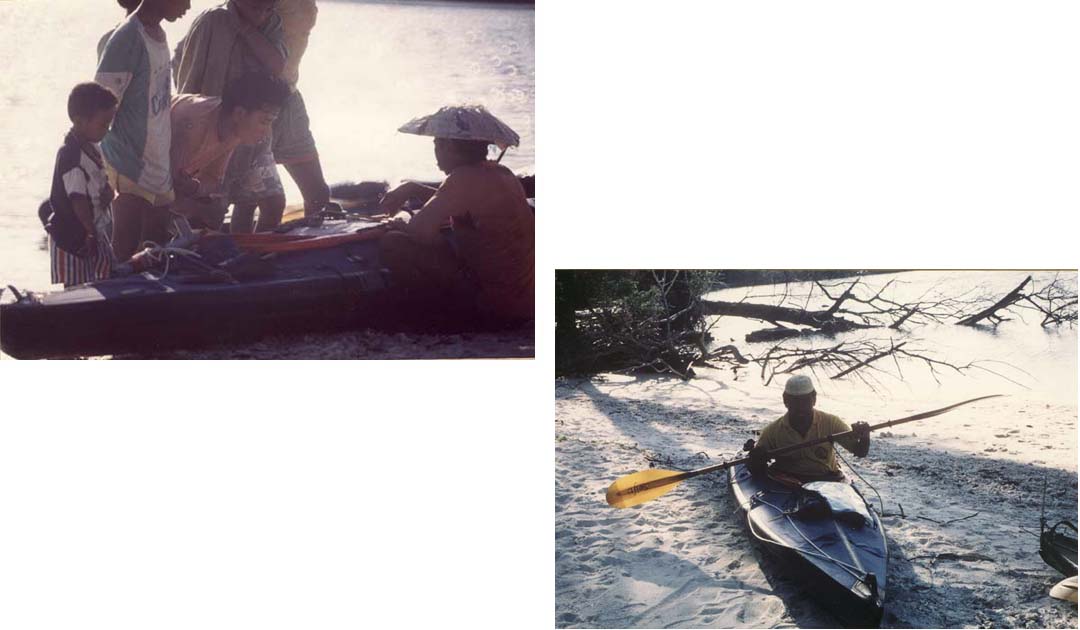
A few steps from the harbor wall was a roofed copra warehouse where we moved our bags out of the rain. It seemed like the entire town watched us assemble our folding kayaks, a double Nautiraid and a single Klepper. Curious and smiling people lined up around our boats, touched the skin, investigated construction details, looked at the paddles, compass, charts and all the other gear. They had probably never seen anything like it before. We made occasional efforts to control the pushing crowd, imagining a minor catastrophe with the boats caving in under a mass of people. We took many pictures of them, but were surprised to hear cameras click as they took pictures of us. Many hands helped us carry the boats into the water a few hours later.
A ten knot headwind whipped up some chop as we started to paddle out of the harbor. The rain had stopped, but it was warm and humid. Several boats started up their motors and followed us for several miles, offering us a tow. We smiled at their insistence. Had they known the preparations behind this trip, the effort we had put in to be able to paddle these tropical waters, they would understand why we declined.
I looked around at the lush green islands, at the swaying palm trees heavy with coconuts, at the rickety wooden boats full of smiling, friendly, brown-skinned locals, at the translucent water with some disbelief. Was it really true that we were paddling our dream vacation? Or was I still in bed in Seattle, wondering about these remote islands, if we would ever get there, about wind and currents and long crossings? Though we had discussed a number of kayaking destinations, in the end we picked the one we first put our finger on: "We've always wanted to go to Sulawesi, and this group of islands seems about the right size." Available guide books had next to no information, since the islands offer little of interest to visitors without a boat. Our charts were from around 1940, in Dutch, and the scale was 1:250,000. We had arrived without any information about tides or currents, but with the islands far apart I didn't expect strong currents. Someone in Banggai had told us that tides were about one meter (probably an underestimate). The guide book stated that May is the rainiest month (but it turned out to be dry and hot almost all the time) and that this was not the windy season.
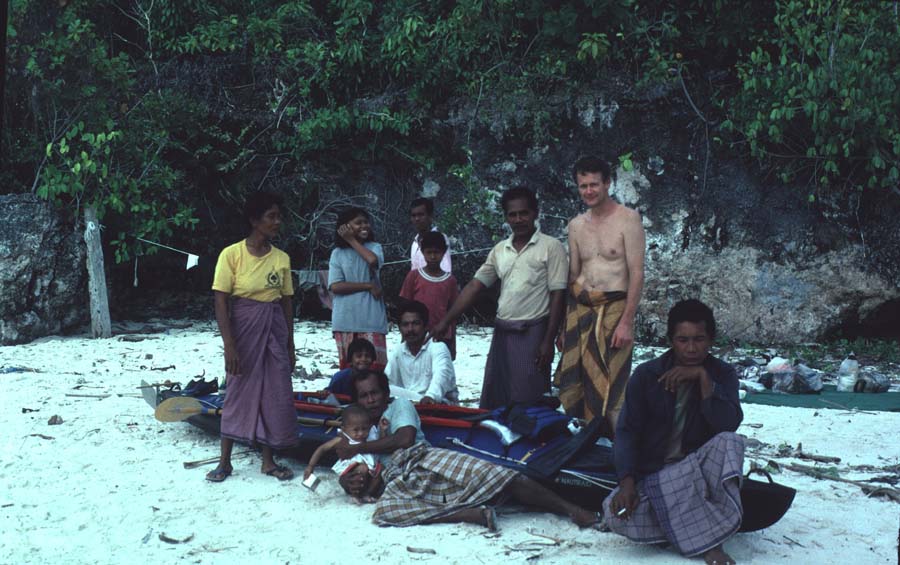
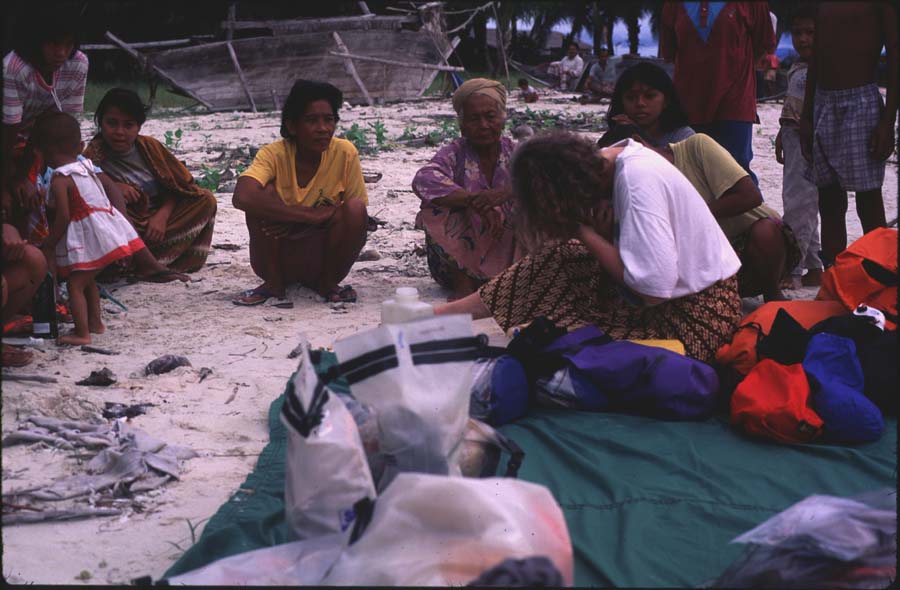
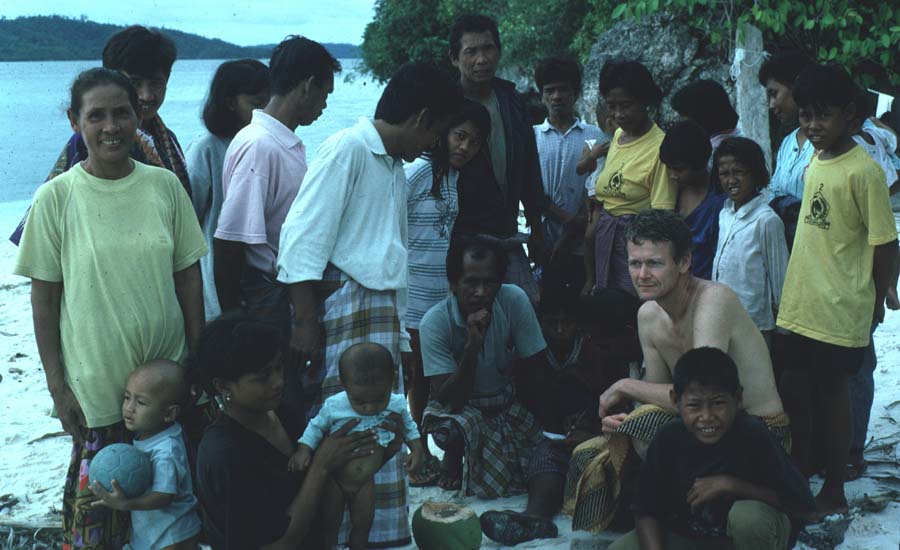
As we came out of the harbor bay the wind dropped and the sun started breaking through. We headed for Bandang Island about six miles away. A couple of hours of easy paddling on a smooth sea took us to an inviting beach with a village nearby. A man was walking along the beach, and using our best Bahasa Indonesia, we obtained permission to camp. As we unloaded our kayaks, many more villagers joined us; men, women, and children, many wearing sarongs, the traditional Indonesian wrap-around skirt. We donned our own sarongs, and, seeing our clumsy ties, they offered us instructions on how to wrap the sarong: run it around your back, fold it several times across your front, and then roll it at the waist a few times for a good fit. This was a very comfortable piece of clothing in the hot climate.
I could but marvel at the beautiful faces, the brownish gold skin color, the inquisitive minds surrounding us. These people live on an island no more than a hundred meters across and depend on their dugout canoes for fishing. Naturally, they were drawn to our water craft and especially our fiber-glass paddles. Their own paddles were carved from wood, often with a beautiful design, but not as efficient as ours. Many inquired about the weight of the boats, how fast we paddled, etc.
We spread out our big tarp on the sand. People gathered around the perimeter. Nobody spoke English, though some people had obviously studied it, judging from their vocabulary. However, we had foreseen a language barrier and taken private lessons in Bahasa Indonesia, the national language (a second language for many). Armed with a phrase-book and a dictionary, I took a deep breath and dove into their language. It was amazing how much mileage I could get out of the little I knew, how the dictionary was passed from hand to hand, how they all did their utmost to communicate with us.
This was a thrilling afternoon, a highlight in my life, sitting on this beach, surrounded by the friendliest people. Somebody climbed a coconut palm and brought down three young coconuts full of succulent juice, and opened them for us to drink (funny, our big noses that drew so many comments, were in the way when drinking coconuts). I had planned for an unforgettable birthday, but this was more than I dared dream for. In the evening, somebody brought a simple ukulele, people said Happy Birthday and sang, but it was refreshing to notice that the even birthday number was no big deal here. Dark palm trees were outlined against the golden full moon.
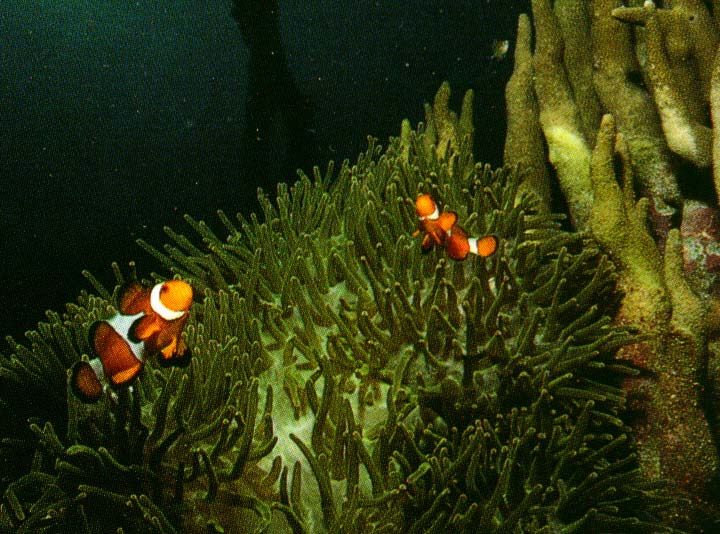
The next morning we paddled around Bandang Island. Through the shallow, crystal clear water we could see corals everywhere. We tied the kayaks to a rock away from the shore, donned snorkeling gear and slipped into the water. We saw long-spindled black sea urchins that had royal blue rings painted in the shell's surface. There were countless species of fish and corals. An unusual fish clustered near with angel-like wings, the Banggai cardinal.
We were glad to be in stable folding kayaks, so we could climb back into them from deep water. It was strangely calm as we made the four mile crossing to large Labobo Island. Bottlenose dolphins played around us, easily recognizable with their long snouts, and we also came upon a large sea turtle. After lunch and a refreshing swim, we set the course for Bangko Island. We had planned to make a detour to avoid a long open crossing, but with this calm weather we decided to take a shortcut. Eight nautical miles of open water was about twice as long as any crossing we had done before.
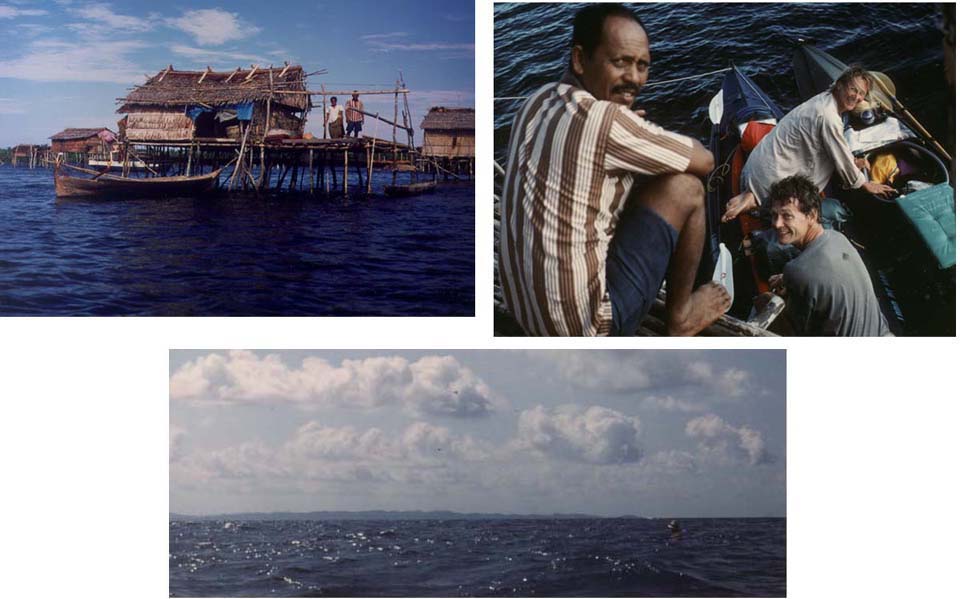
Looking at Bangko Island, we reflected on the curvature of the earth. As we started this morning, the island was not visible above the horizon. Now, being closer, we could see parts of it sticking up. It looked almost like a mirage, gray and faint rather than lush green. Sitting in a kayak, the horizon is only one and a half miles away. You can see a beach that is two feet high when you are three miles from it; when you are further away, you only see the trees above it.
The crossing took longer than expected. Could there be currents out here? When we got closer, a village appeared on the left, still far away. As the sun turned golden and sank down behind us to the north (we were just south of the equator), we realized that there were no beaches here. The mangrove was thick everywhere, and what looked like beaches, were corals exposed at low tide. It got very shallow, and our kayak bumped against the corals once. Where were we going to spend the night?
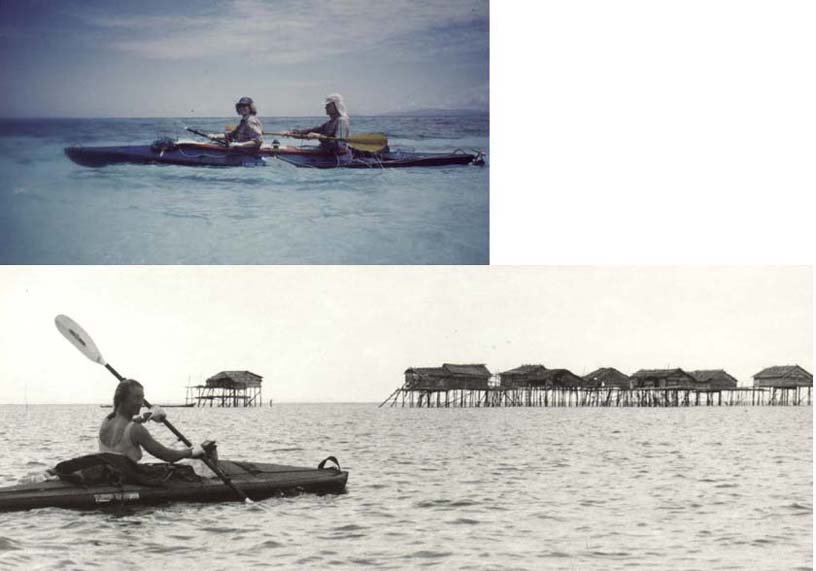
There was not much time before nightfall, so we followed some poles marking a route to the village. There was a current here. Several dugout canoes met us, and seeing our cautious approach, people called out Bagus! (good, beautiful) and pointed the way to the village. But their canoes could take more abuse than our kayaks. To our surprise, we realized that the entire village was built on stilts away from the shore and mangroves (and bugs).
One of the huts looked empty, and to our question Kami boleh tidur di sana? (May we sleep there), we got an enthusiastic Boleh! (Yes you may) as answer. The entire construction was out of bamboo. A ladder led up to a wobbly floor of bamboo slats. In many places pieces were missing, offering a view of the water below. We spread out our large tarp on the verandah and cooked our dinner.
A local villager climbed up with a strong kerosene lantern. I encouraged him with a Silakan duduk (Please sit down). Soon there were four or five dugout canoes tied up, and ten or so villagers gathered around us. Distant lightning crossed the sky. If I am asked to list the most exciting moments in my life, I know this would be one of them, sitting outside the stilt house above the corals, conversing in Indonesian with eager villagers, beholding the full moon, listening to the dugout canoes tug at their moorings.
Weary from the long crossing and lulled by a good dinner, we collapsed where we sat on the tarp under the stars. When I woke up in the middle of the night, I noticed Elli sitting up and saying that a storm was approaching. To accentuate her words, a strong gust suddenly shook our hut. We quickly gathered all our stuff and carried it inside, careful to avoid the big openings between the bamboo slats. Heavy raindrops started to fall. The roof over the bedroom had several holes, so we put the tarp over us. There was quite a commotion outside as the villagers yelled between the huts and retied their boats.
As I listened to the squeaking of the hut, felt it shake in the violent gusts, and heard the wind howl and the waves crash outside, I had to assume that it had withstood many storms like this one in the past. But then again, why were almost half of the huts in the little village abandoned? The kayaks were well tied, so they should be fine. After some time it got almost quiet and the rain stopped. The end of the squall or the eye of the storm? The wind suddenly came back in full force. There was no more rain, but another concern. The tide was now high, and we could hear the waves crash against the stilts. Would they reach us from underneath?
Eventually it started to calm down. From the next hut we heard an eerily beautiful song. As we peeked outside our home, we saw a man sitting by himself under the bright star-lit sky and singing. Was he thanking his God that the storm did no damage? The majority of the islanders were Catholic and some were Muslim, but we understood that many pre-Christian and pre- Muslim practices were retained.
The wind was light and the sun was hot again the next morning. We enjoyed paddling in swells on our six and a half mile crossing to the north Treko Eil Island. Near shore but in deep water there were lots of whitecaps as the waves got steep and choppy. Why were they breaking here? There was no obvious current. Maybe there was a sharp shelf under us as it got deep, causing the waves to change direction and break.
We arrived early and enjoyed a lazy afternoon with the beach all to ourselves, reading, writing postcards, and catching up on diaries. We rigged up the tarp on some extra poles to protect ourselves from the intense sun. One of my drybags had had a small leak. As I spread out my rupiah and dollars to dry, there were comments that this remote place must be good for laundering money.
There was a small stilt village around the point. It seemed almost abandoned and was oddly positioned away from shore but completely exposed to a fetch of more than ten miles. How could they weather storms here? The water was quite shallow, so maybe the waves broke and lost their power before hitting the houses. But why didn't they build their village on the sandy beach where we chose to camp? The answer came at dusk, when we were assaulted by no- see-ums and later mosquitoes. This was our first buggy night. The no-see-ums were fierce, much worse than their counterpart in the Everglades. They left big bite marks that stayed for many days. Our feet and lower legs were full of red marks, especially before we learned to cover them with clothing.
The mosquitoes arrived when it was dark and the no-see-ums were gone and were not as easily deterred by clothing. Our electronic (high pitch sound) repellent was quite ineffective. Coils and strong repellent seemed more effective.
The following morning we crossed over to the south Treko Eil Island. Again we were enchanted by friendly islanders, paddling alongside us in their dugout canoes, and inviting us to their protected stilt village.
After lunch we headed towards Poposan Island six miles away. There was no wind and I was a bit lax in navigation. When I checked our position about midway, I realized we were way off course, too far to the left (east). Elli confirmed this with her GPS. Rather than trying to fight the current, we changed course for small Badi Island. After some hard paddling I could yell out "Beaches at wave crests!", meaning we were some three miles off. Closer, about half a mile from the island, our kayaks cut through noticeable whirlpools and then an eddy-line with an eddy on the other side. So there were currents even out here. We would need to figure out how its direction related to low and high tide.
Badi was like a dream. A small island ringed by nice beaches and coconut palms, flat open areas and no bugs. Though we were alone at our campsite, we were aware of a village on the other side. The coconut palms were marked "private", so we refrained from collecting any coconuts.
Out of several islands to the south of us, we chose to paddle to Pobongkoli. Finally we got some whitecaps as we headed into a ten knot wind. This time I checked the navigation better. A 15 ferry angle kept us on course. This appeared to be another mangrove island without beaches, so we tied up to a thirty foot wooden fishing-boat anchored away from shore. Three smiling fishermen seemed as surprised as delighted and welcomed us aboard. But first we plunged into the turquoise water to cool off and enjoy the magnificent underwater scenery. Colorful coral contrasted against the white sand. Fish swam everywhere. Some brown coral was adorned with tiny animals looking like colorful butterflies. The crown was a giant clam burrowed down in the sand.
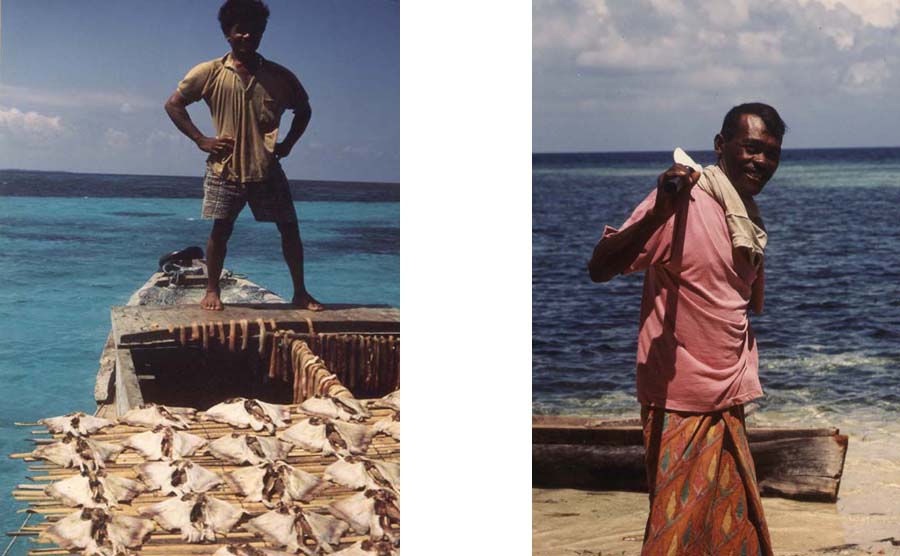
We had to move gingerly when we climbed aboard the surprisingly tippy fishing-boat. On the deck and top of the cabin there was fish spread out to dry everywhere. Most of it looked liked tiny stingrays. We were invited to the long but narrow cabin. We chatted with the men as we ate our lunch, sitting cross-legged under the low ceiling. It was sparse in there, but in a drawer near the wheel there were some tools and a small, wobbly compass. An older man kept laughing and talking to us. He had barely any teeth left and was quite hard to understand. They told us that the only fresh water supply in the vicinity was on Badi Island, from where we had just come. But we still had several days supply.
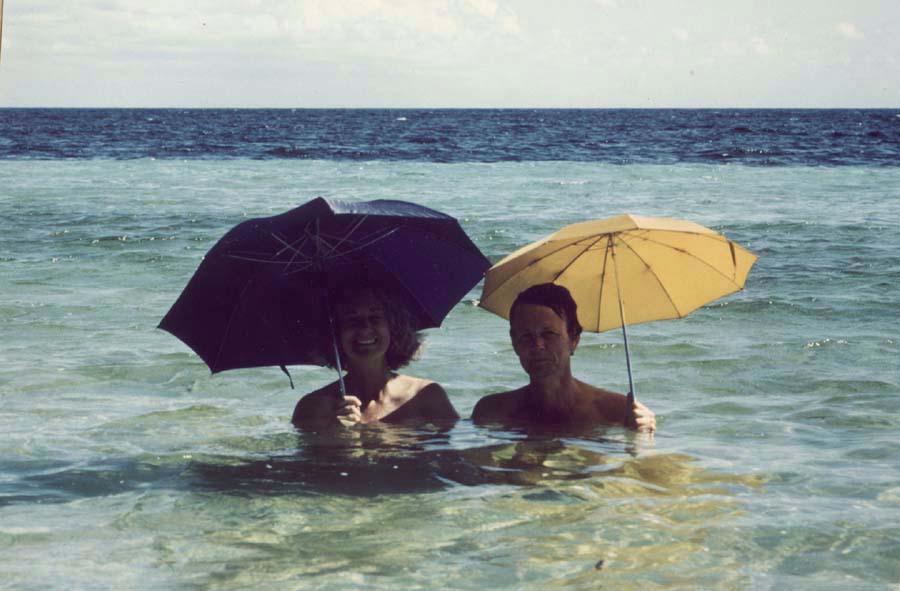
With no beaches on Pobongkoli we crossed over to one we could spot on nearby Togong Bojoko Island. A nice campsite in the shade invited us to a three day stay. These were lazy days with lots of swimming and snorkeling. I felt funny sitting in shallow water to cool off but with an umbrella to protect myself from the sun. But then again, only my two compatriots could see me. Togong Bojoko was the last island before the Sea of Banda, where we could see swells break on the coral reefs. We paddled out to the reefs a couple of times. Schools of greenish flying fish skipped along the water. The reefs were a coral fantasy land. Fan shell corals in all sizes and colors were swarmed by beautiful fish. It was hard to stop snorkeling, though I did get a bit tired towing the kayak in the surf break.
As usual there were bugs at dusk, but also many fireflies. Their greenish light stayed lit quite long. As the moon rose later and later, we were rewarded with beautiful starry skies. The Milky Way was clearly visible, and we delighted at making out the Southern Cross.
It was already hot early in the morning on our last full day here. I went for my second swim, happily scampering out into the water. A few feet away from the shore I stepped on something hard, and then slipped off. I barely caught a glimpse of a dark shape swimming away. The water above my foot was stained red. It took a few moments before I realized I was looking at my own blood. I turned back and cried out rather meekly "Something bit me", while Surain watched in horror as blood gushed out with every step.
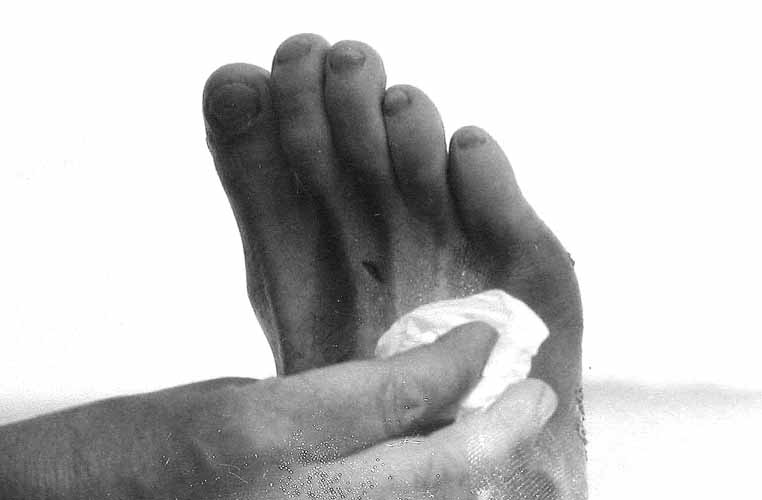
An intense pain gripped my foot. I lay down and raised the foot high. This immediately stopped the flow of blood. Surain and Elli cleaned the wound carefully and put on antiseptic cream and a sterile compress and then wrapped it in an ace bandage. The wound was large, about 2 x 1 cm and very deep. Fortunately, it was between two tendons. The pain remained for about four hours before it subsided.
Though I didn't see what struck me, there was no doubt in our minds that I had stepped on a sting ray hidden in the sand. The locals were very familiar with this danger, and in the next village we would quickly learn a new word, ikan pari, sting ray in Indonesian.
Since we were not able to stitch the wound properly, we decided to give it maximum chance to heal. I would not put any weight on that foot for more than five days, and for the next three days it was always in horizontal position or higher. I would watch sitting on the tarp (sure glad to have a Therm-A-Rest'r chair!) Surain and Elli do all camp chores, pack, unpack and carry the kayaks, etc. My only contributions would be cooking, paddling and navigation (but no longer steering). After a few days of human slings holding my leg aloft, I used the paddles as crutches. We redressed the wound daily, and I wrapped the foot in a drybag to keep it clean whenever I left the tarp or the tent.
Considering the size of the wound and the circumstances, the recovery was very good. But even as I write this six weeks later, there is still a big, red bulge on the foot. And I still avoid putting heavy strain on the foot.
The next morning we returned to Badi to the village to replenish our fresh water. It was a quick crossing with a ten-knot wind in our back. The natives gathered around me as I was helped ashore. Looking at the wound, they cried out ikan pari. I tried to inquire about ocean currents, but nobody understood the word arus from the dictionary. But then again, Bahasa Indonesia is their second language. The following morning we made the seven mile crossing to Telopo Island. The wind had picked up to 15-16 knots, and with it coming from the Banda Sea waves built to 2« feet or so, dwarfing us in the troughs. A ferry angle of 15 kept us on the right course.
Telopo was a much larger island. It rose steeply out of the water, with deep green forests, some consisting of coconut palms. We passed a bay with lots of stilt houses with connecting boardwalks looking almost like a city. With no beaches in sight, we ate lunch on a fallen log near shore. At the northern end we found some beaches where sand was mixed with finely crushed corals, and there were coconut palms nearby. We spent two nights here. Elli found use for the parang (machete) she bought for opening coconuts, and the coconut flesh was a nice addition to our meals. A pair of beautiful green parrots with red beaks flew over the water for a while. After three days away from the water, I put my feet on top of the kayak and dipped and washed the rest of my body. It felt like heaven, and brightened my mood, which had been a bit down due to my immobility. Just wished the sand fleas would stay away .
We often saw dugout canoes go by, and got many visitors. They had probably never seen kelapa putih (white coconuts - their slang for Caucasians) before. They would stop for a short while, chat, look at the kayaks and paddles, and then take off again. One group returned a second time and brought us nice fresh coconuts - the ones we collected ourselves were all old and not as tasty. These visits were highlights for me, seeing these beautiful men, women, and children, talk to them, smile at them, wave at them. Without them, my stay here unable to walk would have been much more difficult.
One evening as we were eating dinner, a man called out "Hello Mister" to us in the darkness. Three men come ashore and joined us. As we told them about our plans to make a long crossing to get back to Banggai Island, they got concerned and warned us about the big waves and the strong current (finally somebody that understood arus - current). In fact, they came back the next day again to tell us when the current was most favorable and also suggested we make a detour to avoid the worst.
I lay awake quite a bit during the night, listening to the wind howl. This was too strong for us to attempt the crossing. If the wind kept blowing like this, would we be able to get back in time for the ferry? The last few days the wind had been increasing continually. We had a cushion of a day and a half, and could maybe make a long detour to avoid the very exposed crossing ahead of us. But there were no protected waters.
The day dawned and the wind calmed down and I felt much better. We left at ten, earlier than recommended but with a five hour crossing or so we hoped to straddle slack water. Ahead lay a 10.5 nautical mile open crossing. To our left there were a few small scattered islands - the closest six miles away - to break the force of the Banda Sea. To our right was the Molucca Sea.
The wind was in our back and eventually built to 13-14 knots. It was deceptively calm, with swells from both sides. The current forced us to angle 25 (even 45 for a while) to avoid being pushed to the Molucca Sea, so we got the waves at an angle. I had expected the ocean waves from the left and the right to merge a mile or two away from shore, but we had gentle swells from both directions for half of the crossing.
Then things started to happen. The swells changed to breaking waves, still from two directions about 45 apart. At three feet or more, they dwarfed us completely. When two merging waves broke, they towered much higher and often hid Elli and her kayak from us. Once we heeled over unexpectedly, and I realized that I needed to pay closer attention and be ready to brace. Still, the kayaks performed beautifully.
Suddenly it got strangely calm, no more whitecaps. We could still see and hear them behind us. The reprieve was temporary, there were more breaking waves ahead. Were these rough/calm areas caused by currents or depth changes? I had probably never before kept such a close tab on navigation. Were we on the right course? Were we making headway as expected?
Closer to Kenaoe Island the current very abruptly changed direction and pushed us to the left rather than to the right. About half a mile from the point it got very calm, only gentle swells heaved our boats. Having expected rough waters and planning to give the point a wide berth, this surprised me. Shortly thereafter, 4 hours after we left Telopo, we had finished the crossing.
Kenaoe Island had steep rocky shores with small caves, against which the waves crashed and foamed, very different from the outlying islands. The island towered high above us as we moved closer to look for a landing spot. We soon found an inviting cove with a narrow beach, just barely wide enough for the tents at high tide. Large trees grew just behind and along the steep slopes. Birds sang hidden in the lush vegetation, and many different kinds of crickets played a virtual symphony as we ate dinner. The setting sun painted the sky and water golden. A large fish trap out in the water was outlined as a stark black silhouette.
The next morning Surain and I paddled north along Kenaoe Island. Several large coves looked very inviting with flat areas, where coconut palms and even some banana trees grew. Often a lonely hut could be seen. One large bay was quite shallow with coral bottom, easily viewed from the kayak. At the north end of the island we continued across the channel towards Banggai Island. With our normal cruising speed of 3«-4 knots we barely made headway against the current, so we headed straight for the other shore to get out of the current. But it was even stronger there and sharp rocks prevented us from reaching the shore. The swells were breaking, and we found ourselves in the biggest whirlpools we had ever paddled. We dug in our paddles, and managed to power through the current and out of it. I judged the current to be at least 4 knots and did wonder what it might be at spring tides.
We joined up with Elli at lunch again and then pushed on to Bandang Island, where we had spent the first night. It felt almost like coming home with all the villagers welcoming us back enthusiastically. They were eager to help us unload the kayaks and pitch the tents and bring us wonderfully fresh coconuts. We spent our last three nights there, negotiating with the villagers to take us with all our gear directly to the ferry early the following morning. It would be much easier to break down the boats there than in Banggai.
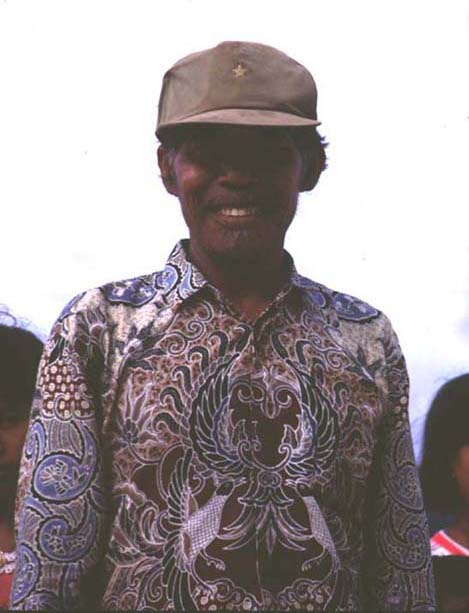
We delighted at getting to know the people better. There was the stately woman we called Grandma, often carrying a little child. Edy was young and eager to help and knew a number of words in English (but no sentences). He was the one organizing the boat transports for us and with whom we negotiated the price (though he didn't set the price himself). Emana was a young girl with big wondering eyes, often sitting on the tarp across from me, never tiring of looking up words in the dictionary. She often found strange words that probably were common in Indonesia, but not in a Western society. Gregorius was in his thirties, a strong man who also liked to be close to me and joked a lot. He was of a different race and came from Irian Jaya (Indonesia's half of New Guinea). Then there was the musician who played the ukulele, the proud man with his wife and children, and many, many more. We felt very fortunate to get to know such warm and friendly people.
My grasp of Bahasa Indonesia was getting better, so I asked them if foreigners had visited Bandang before us. An American couple spent three hours on the beach in 1995. One man spent six hours on a nearby island in 1992. That was all - and they all arrived by "speedboat" (a generic term for a small powerboat; often quite slow). Considering how close this village was to Banggai town with ferry service, we suspected that some of places we had visited may never have seen Westerners before.
There was a small explosion from a dugout canoe. Bombs, we were informed. Dynamite is used throughout the tropical world to catch fish hiding under coral reefs. Unfortunately it destroys the reef as well. We knew the technique was being practiced here and had seen signs of it, especially near villages. Still it came as a shock to witness it firsthand. We learned a new phrase, hancur karang-karang, (destroy coral reefs), that we rather hadn't learned. We tried to voice our concern, but we were in no position to criticize. Cutting down old-growth forest like it is done in the Pacific Northwest is no better.
The last morning we left Bandang before five in the morning in a "speedboat". As we pulled away in the darkness, my eyes got wet - this was a place where a part of me would be left behind, with unforgettable memories. In the distance Ciremai could be seen approaching the harbor.
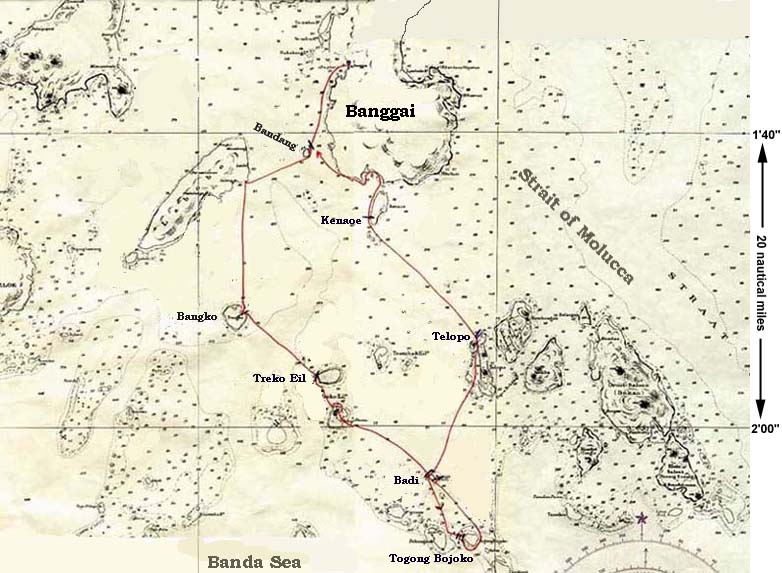
May 20: Banggai -> Bandang Kecil     6.5
May 21: Bandang -> Bangko           14.4
May 22: Bangko -> N. Treko Eil       6.8
May 23: Treko Eil -> Badi           10.1
May 24: Badi -> Togong Bojoko        5.5 + 1
May 25: Togong Bojoko                  - + 5
May 26: Togong Bojoko                  -
May 27: Togong Bojoko -> Badi        6.5
May 28: Badi -> Telopo              10.4
May 29: Telopo                         - + 1
May 30: Telopo -> Kenaoe            11.1
May 31: Kenaoe -> Bandang Kecil      9.4
June 1: Bandang Kecil                  - + 1
June 2: Bandang Kecil                  -
Total: 80.7 + 8 nautical miles (93 + 9 statute miles)