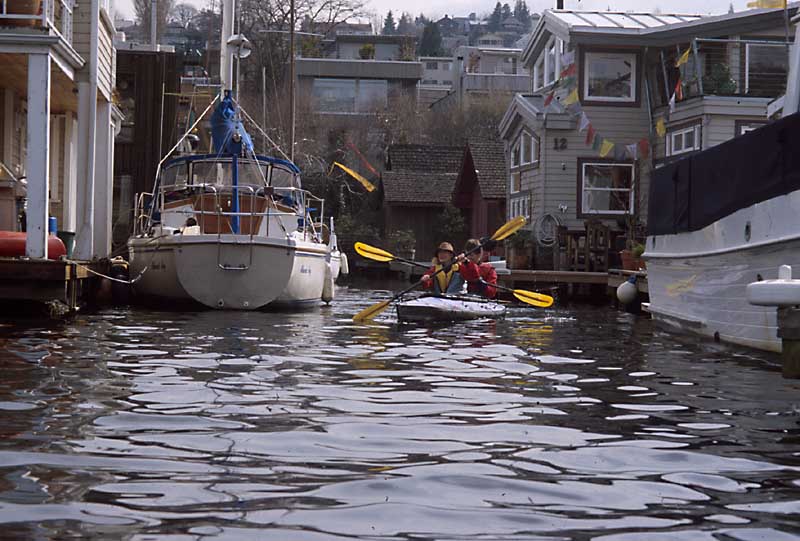
We hadn't used our double kayak yet this year, but with warmer weather we had certainly felt the urge to do so. Though the Saturday forecast (March 23, 2001) wasn't wonderful, it sounded like the rain wouldn't start until the evening. So Surain and I and our good friends Tanya and Al launched our two double Nautiraid kayaks in Lake Union in Seattle and headed for the locks out to Puget Sound. The plan was to get out into the saltwater for a while and then go back the same way.
|
|
Leaving our houseboat (76 kb) |
It is just under an hour's paddle out to the locks. Lake Union is a very diverse lake with houseboats, floating homes, restaurants, paddling clubs, pleasure boats, fishing boats, and commercial outfits. But we steered out through the canal and a small lake that leads westwards to the locks under a couple of bridges. In the beginning we followed the lush green trees on either side of the canal. This is a park, and in the summer there are lots of people here, walking, running, sunbathing, eating their lunch, or just lazing away. But today it seemed completely deserted.
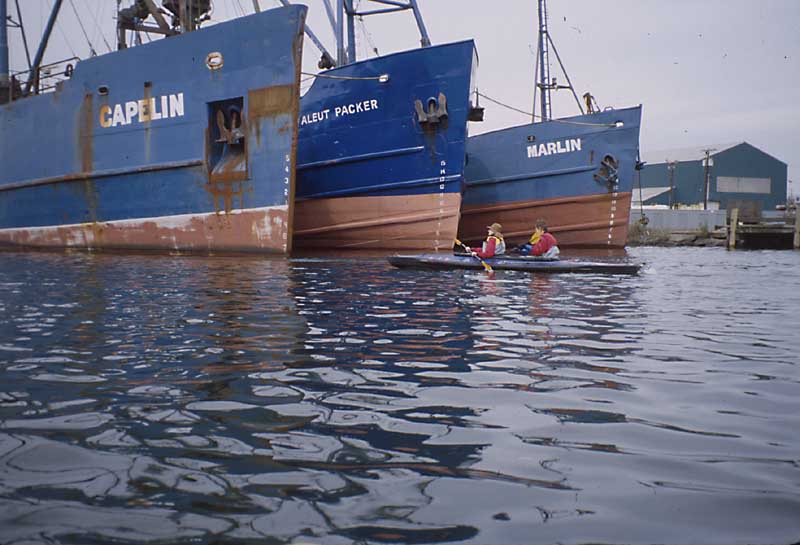
The canal then opens up a little bit into the small lake. First we passed by the fishing harbor. Seattle is a major fishing port, and there were lots of boats docked here. We were surprised to see quite a few houseboats moored. We hadn't noticed them during earlier trips, and made a mental reminder to paddle by closer on the way back if time would admit. Here like in Lake Union we found many pleasure boats. Many people go exploring the beautiful archipelago outside. Still commercial ships is by far the most noticeable part of the seascape. This is one of the centers of the shipping industry in Seattle. We found it quite interesting to glide through these big ships being unloaded, repaired, repainted, sitting in dry docks, etc. Even on a Saturday it simmered with life and gave a completely different aspect of kayaking.
|
Big ships (60 kb) |
There are two locks out to Puget Sound. One is small and only holds a few boats. The side that you tie up your boat to floats with the water, so you can just secure a line to it while the water goes up or down. This is the lock that we had used almost every time before. One reason is that it is so much faster than the big locks. As a kayaker, there is always room for you in the locks. In the summer, bigger boats sometimes have to wait many hours to get through.
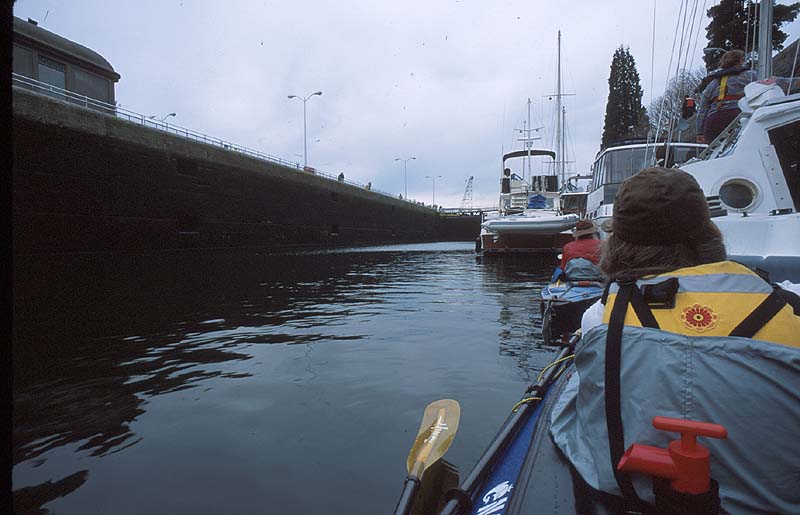
But the small locks were closed today, so we headed into the big locks. These are much larger and can hold pretty big commercial ships. The sides are solid concrete, so all the boats tied up to them have to watch their lines as the locks go up or down. This does not affect kayaks, since they are always asked to tie up outside a pleasure boat. Fortunately we only had to wait a few minutes. This area is also a park and it is one of those areas in Seattle that tourists flock to.
|
Inside the locks heading for the saltwater (57) |
On the other side we could breathe in the salty air. We are definitely saltwater paddlers, and it felt so refreshing breathing the sea air, seeing the open water with all the sailboats, watching all the birds, listening to the sea lions - a scenery so completely different from the commercial harbor - but both very interesting.
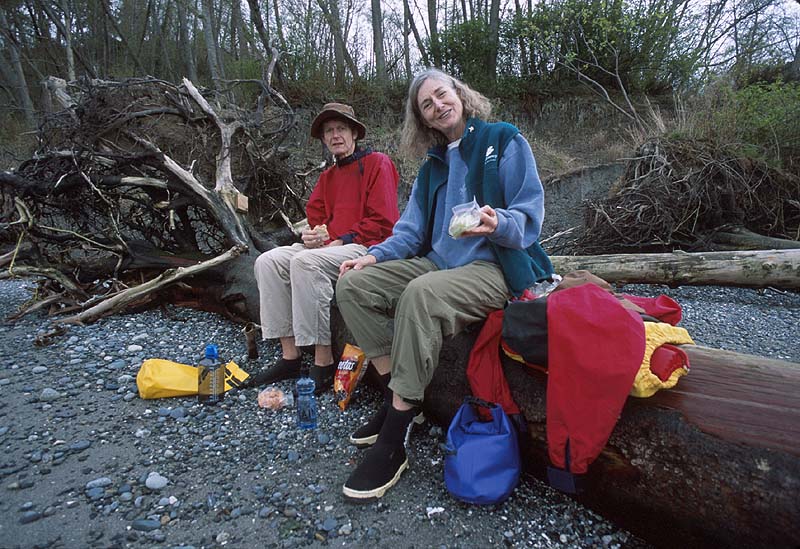
Most of the area west and south of the locks are parks, and we spent several hours paddling around, having lunch on shore, and just basically enjoying life.
|
Lunch (121 kb) |
Then we headed back to the locks. There wasn't much activity there and we could only see one powerboat waiting for the locks to open. There wasn't much we could do, so we lazed away in our kayaks. Half an hour passed and we started wondering if we should portage the kayaks to the fresh water. We had dinner plans and it was still over an hour to get back to our home.
It was easy to launch where we were, but we weren't sure about the other side. Two of us decide to go and check it out. But they had barely stepped ashore when we spotted a large commercial boat coming in to the locks from the other side. Good! That meant that they would let us in after this boat had been transported down through the locks.
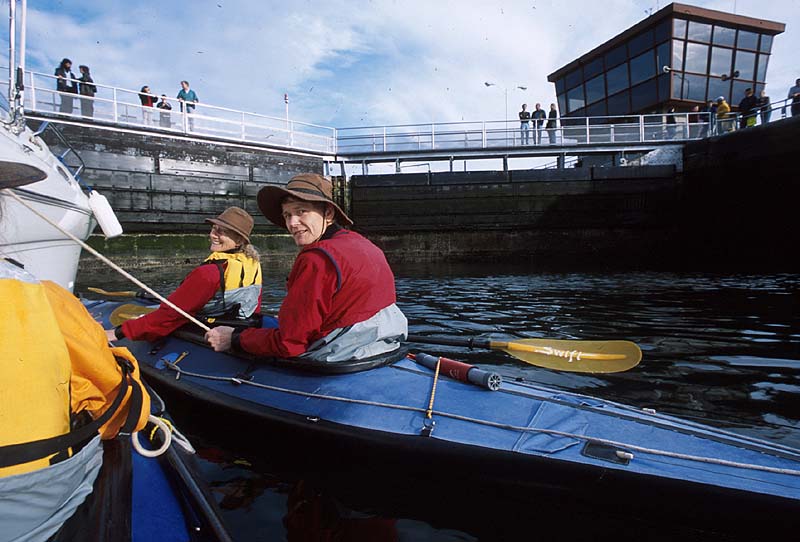
As the big ship entered the saltwater and disappeared, we were beckoned that we could enter after the two powerboats. A tugboat then came just after us. The lock operator positioned one powerboat at the head of the lock, the other boat outside it, Tanya's and Al's kayak outside that, and finally our kayak outside their kayak. If there is room, they often position boats outside each other, so the outside boats don't have to deal with watching the lines. The tugboat moored behind us.
|
Inside the locks heading back to the freshwater (76 kb) |
The powerboat was short and high, and there wasn't really anything that gave a firm grip to hold on to. They gave us a line to grab. The gate to the locks was closed, there was the upwelling of water as they filled the locks. They were just about ready to open the gate on the other side so we could continue into the fresh water, when the lock operator told us that we were going down again. And so we did. What was going on? Had a new ship arrived?
The gate was opened on the saltwater side again. Two tall sailboats had arrived, and they were sitting just outside a railroad bridge. It seemed like we were waiting for the sailboats, and the sailboats were waiting for the bridge to open, and the bridge was waiting for a freight train to move away. But the train did not move for ten minutes or so, and there we all sat waiting.
Finally the train started moving, and then, finally, the bridge opened. The sailboats powered into the locks. And then after them we saw a tour boat approaching and lumbering into the locks. So that was what we were waiting for. The gate to the locks closed, the upwelling of water started, and we rose again - and this time all the way up.
We were up at lake level, and the lock operator cautioned the boats to tighten their lines and yelled to us to hold on tight. Then they started opening the gate. This is always done when the water in the locks is about half a foot below the lake level. We assume this is to prevent saltwater from flowing into Lake Union.
We watched as the water started rushing towards us, and so did all the spectators. There was a fair sized crowd now in the afternoon with fairly nice weather. People always enjoy watching boats going through the locks. Kayaks are rare and give an extra spike to the event. I was fascinated watching the water head toward us, but oh so slowly. It didn't rush straight for us, but instead spread towards the sides and slowly inched closer.
But we were very close to the gate, so the water soon caught up with us. Furiously it lashed at our kayak and pushed the bow closer to Tanya's and Al's kayak and the boat. There was no way we could stop it with no good grips. The water bubbled and churned and squeezed the front of our boat down. Water reached just above the coaming where Surain was panicking in front of me. Our boat started listing away from the other boats, and the bow was pushed under the other kayak. Surain said she felt the boat flipping over and saw herself being dragged under the surface of the water by the relentless current.
The situation was a little bit better where I was sitting, but I immediately leaned the other way and grabbed the other kayak for all I was worth. So did Tanya and one man on the boat. Somehow I never had the fear of capsizing that Surain did. I felt the buoyancy would eventually catch up with the downwards movement. We managed to hold the kayak in place, and there it sat for a while as the water rushed past us. Then slowly it started popping up again. After a few minutes wait, the lock operator yelled to us to start paddling. Easy for him to say! Giving it all we were worth, we could make a very slow headway, and the current gradually dissipated.
How could this happen? How could we be fighting for our lives in one of the most public places in Seattle? We had paddled through the big locks the same way once before, several years ago and in single kayaks. But each kayak had been placed next to a low boat with good support. Though it had been a bit unpleasant, I never felt any fear at that time. Maybe the current was much stronger today? I feel that it was a disastrous mistake this time by the lock operator to place our boats side-by-side. If we had been next to a big boat, we could not have been pushed sideways nor could we have been pushed under another boat. Tanya and Al were placed thus and did fine in their kayak.
Our double Nautiraid is quite short, 16½ feet, but it is very wide, 35 inches. Together we weigh about 280 pounds. Since this was a day trip, we did not carry any heavy equipment. I don't think a single kayak would have had any chance in the world to avoid capsizing. Even big doubles would have had a hard time to stay afloat. Our kayak is one of the most stable on the market and has air filled sponsors on each side to increase buoyancy.